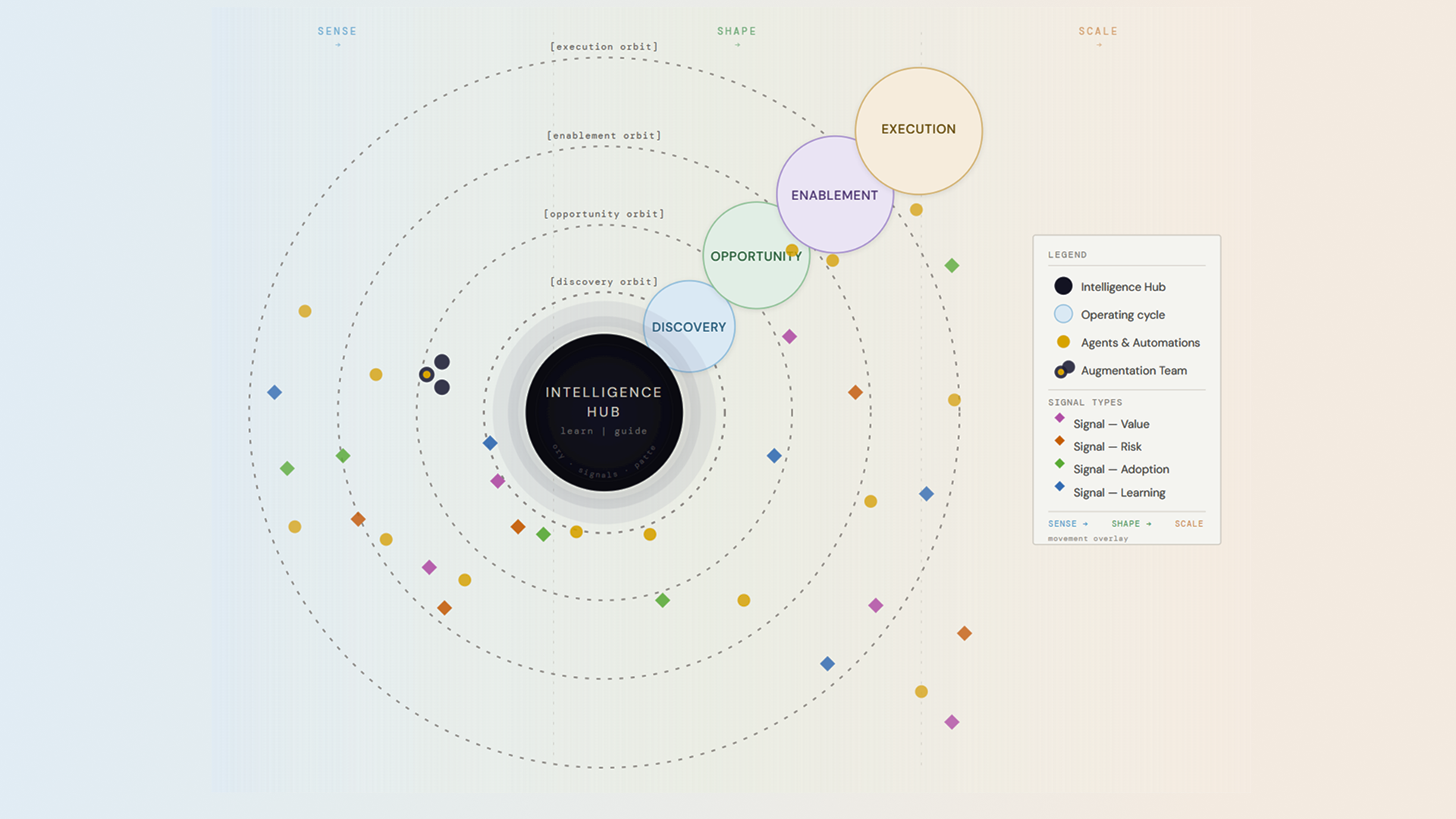
The bottleneck was never ideas. It was the time between a signal and a decision.
Organizations have spent decades building innovation processes designed to generate options, align stakeholders, and document progress. What they did not build was the capacity to move. Discovery phases stretched into months. Decision gates multiplied. By the time a pilot was approved, the signal that triggered it had already changed. The problem was never creativity. It was a system architecture that treated every decision as a destination instead of a movement.
The arrival of AI did not fix this. It exposed it. Organizations that layered AI tools onto existing processes discovered they could produce more output faster — and still not decide. More output. Same bottleneck. The gap was never in the generation of ideas or the documentation around them. It was in the infrastructure that connects a signal to a decision, a decision to something built, and that build to the next learning signal. That infrastructure did not exist.
MESH is what it looks like when you build it.
Not faster documents. Different ones.
The arrival of AI into organizational workflows was supposed to change the equation. In some ways it did. Synthesis that took days now takes minutes. Research that required teams now requires a prompt. Artifacts that were produced in weeks — audits, requirement documents, process maps — are now produced in hours.
But most organizations made the same mistake. They handed AI to the people already doing the work and told them to go faster. The process stayed the same. The decision infrastructure stayed the same. The bottleneck moved slightly — and then returned.
The organizations that responded differently did not just use AI to accelerate existing outputs. They changed what outputs are. A site audit is no longer a formatted PDF assembled by hand over three weeks. It is a living document, generated from ingested recordings, observations, and click-through data, assembled in hours, ready to feed directly into the next decision. A prototype is no longer a static wireframe with annotated screenshots. It is a working artifact with AI-written functional notes embedded as a toggle layer — readable by humans, usable by AI-powered development systems. A handoff package is no longer a set of slide decks. It is a structured set of machine-readable files that a development team's AI systems can ingest and act on immediately.
This is the artifact shift. Not faster documents. Different ones. Built for a world where the next tool in the chain is also intelligent.
The tools changed. The artifacts changed. The speed changed. The operating system did not.
Most innovation processes in use today share the same underlying architecture: a linear progression from discovery to definition to delivery, punctuated by approval gates and review cycles designed to manage risk in slow-moving organizations. They were built for a world where information was scarce, synthesis was slow, and the cost of a wrong turn was high. That world still exists in parts. But it is no longer the dominant condition for organizations serious about AI-era innovation.
When information is abundant, synthesis is instant, and artifacts can be generated and iterated in hours rather than weeks, the constraint shifts. The question is no longer how do we gather enough to decide. It is how do we build a system that keeps the signal alive long enough to act on it. Discovery phases that stretch into months do not produce better decisions in this environment. They produce decisions made on signals that have already moved.
What was needed was not an improvement on existing processes. Iteration on a system designed for a different era produces a faster version of the wrong thing. What was needed was a system designed from the ground up for the conditions that actually exist now — where AI participates in the work, where artifacts are intelligent, where the loop between signal and decision and build and learning runs continuously, and where the team operating the system is as much AI as it is human.
That system needed a name.
A continuous operating rhythm, not a sequence to follow.
MESH is an AI-native decision acceleration system. It connects signal to decision, decision to build, build to adoption, adoption to learning — and learning back to the next signal. Not as a sequence to follow. As a continuous operating rhythm.
The name is not an acronym. It is a metaphor. Interwoven. Connected. Living. A system where every element affects every other, where nothing operates in isolation, and where the intelligence accumulated from each loop makes the next loop faster and better-calibrated.
MESH was not designed in advance and then applied to problems. It emerged from the work — from the repeated experience of reading a system, deciding what to build, producing what builders needed, and watching what happened when real users encountered it. The pattern was already there. MESH is what it looks like when you name it.
At its center is the Intelligence Hub — the memory layer of the system. Everything orbits it. Every signal flows into it. Every decision draws from it. The Hub does not store documents. It accumulates organizational intelligence: context, patterns, signals, learning from every loop that has passed through the system. Its function is two words: learn, guide. Most organizations lose this intelligence between initiatives. Projects end, people move, context evaporates, and the next team starts from somewhere close to zero. The Hub is what prevents that. It is not software. It is a function — and in a lean operation, an AI partner performs it right now, without enterprise infrastructure, without implementation cycles, without a procurement process.
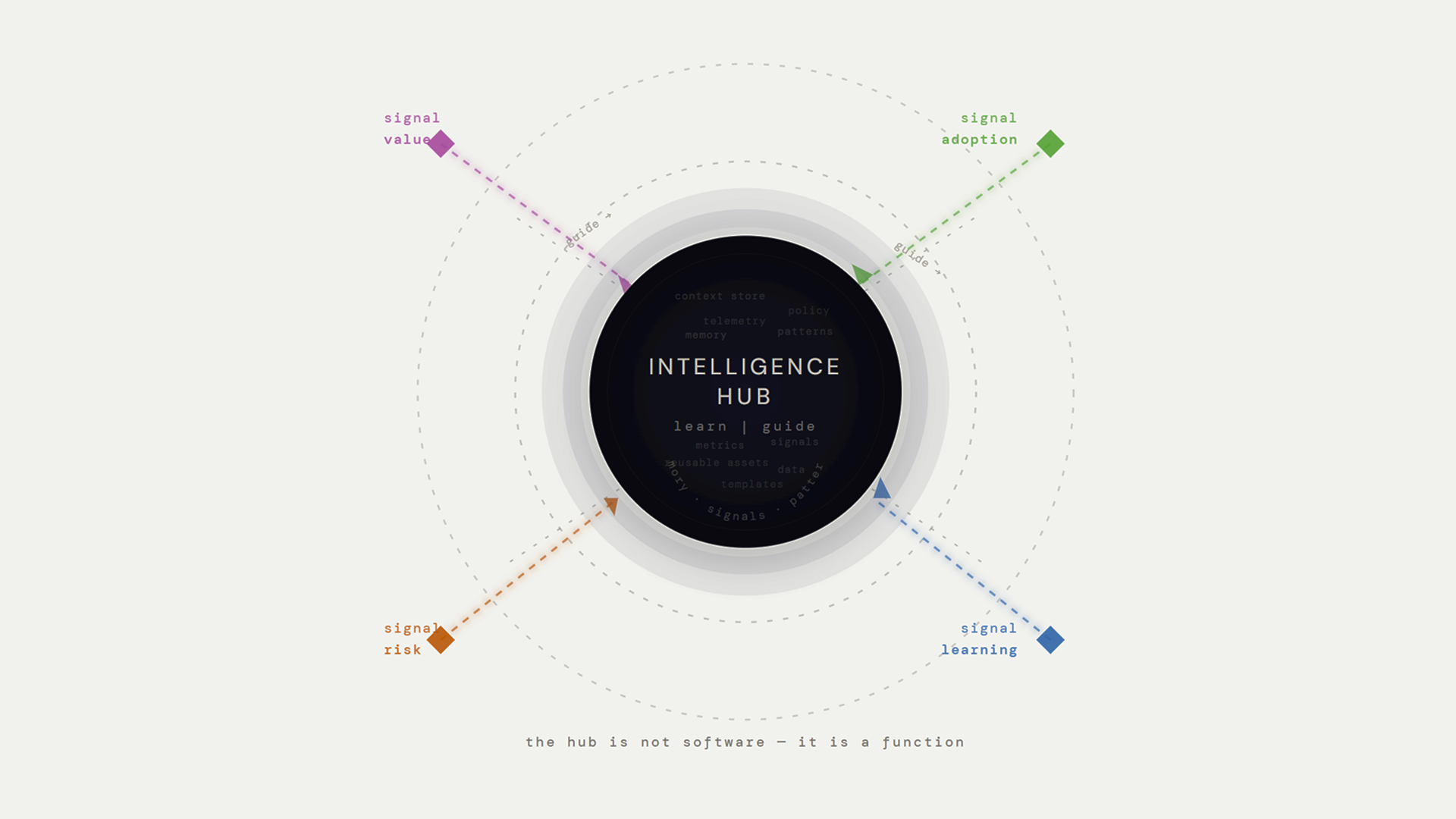
This is what made MESH possible before it had a name. The Intelligence Hub was already running.
MESH moves.
MESH moves. That is the most important thing to understand about it.
Not through stages. Not through phases that begin when the previous one ends. Through continuous movement — a rhythm the Augmentation Team dances to regardless of where in the system the work is happening. Sense, Shape, and Scale are not steps on a process map. They are modes of operation. A team can be Sensing inside an active deployment. Shaping while something else is already Scaling. The movement describes how the team is operating. The orbits — which we will come to — describe where the work is focused. These are two different things.
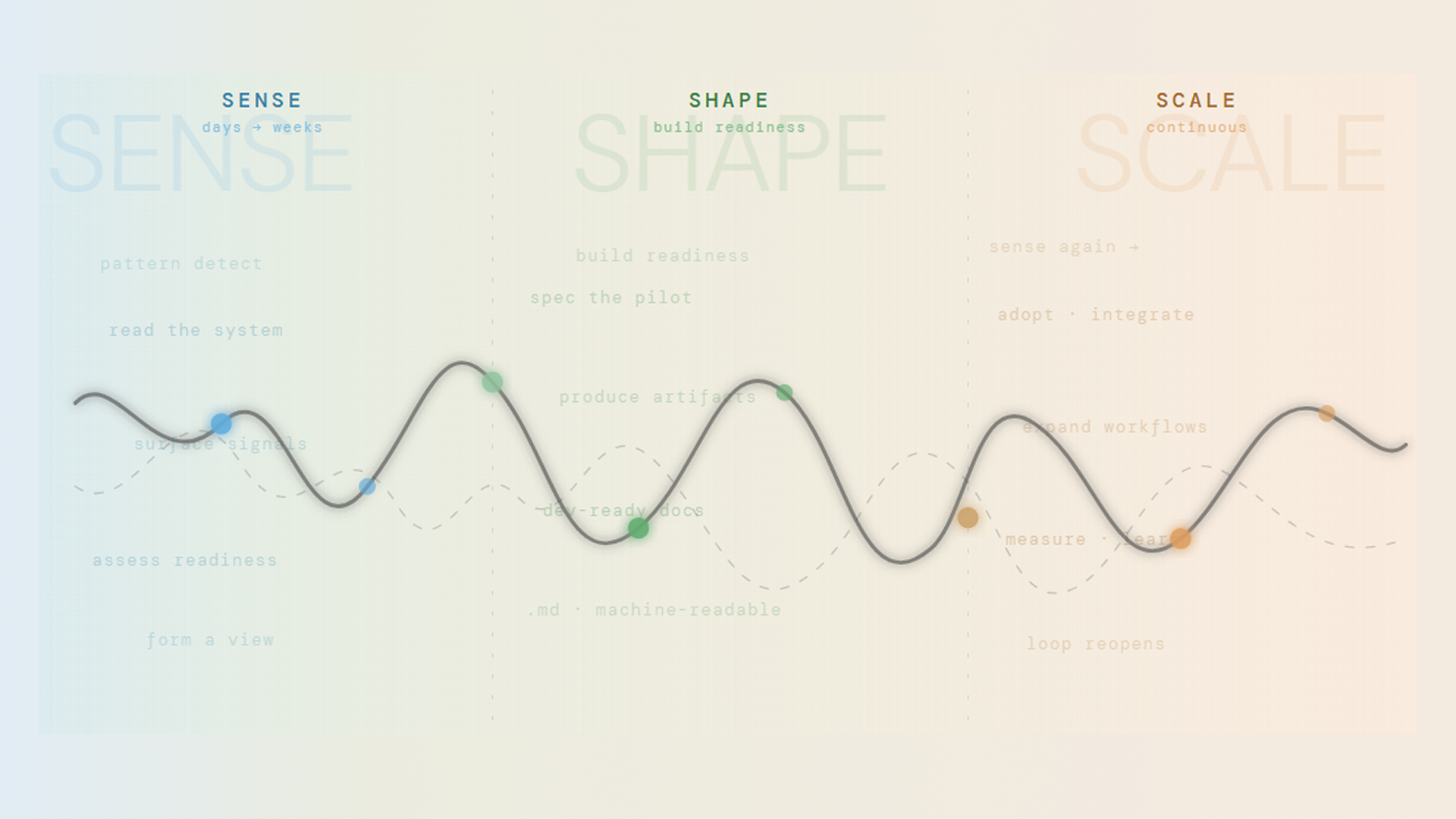
Sense is the act of reading the system. Surfacing signals before committing to direction. The Augmentation Team — strategy, product, technology, and AI working together — functions as the sensing instrument, each member picking up different frequencies from the same environment. Sense does not end at observation. It ends when there is enough clarity to act. In a high-functioning team, this can happen in days. Sometimes in a single conversation. The signal map, the readiness assessment, the pilot options — these are not deliverables to be presented at a gate review. They are the record of what the system revealed.
Shape is triggered by one thing: readiness to build. Not a calendar milestone. Not a completed checklist. A signal from the client or the organization that the moment has arrived. When that signal comes, Shape produces everything builders need to act — structured, machine-readable, AI-native artifacts that the next tool in the chain can ingest immediately. This is not documentation. It is infrastructure.
Scale is adoption, integration, and expansion into live workflows. But Scale is not a final phase. It is the moment the loop completes and immediately reopens. While one initiative is scaling, the system is already sensing the next signal. The organization does not pause. The rhythm does not stop.
In Brazilian capoeira, ginga is the continuous lateral movement that keeps a fighter adaptive — never static, never committed to a single position, always reading and responding. This is not a borrowed metaphor. It is the closest description of what MESH actually feels like when it is working. Not a march with defined steps. A dance with a clear destination.
Every system needs a language. In MESH, that language is signals.
Signals are not reports. They are not status updates or meeting summaries or findings decks. They are live inputs — information the system is actively generating as work moves through it, continuously feeding the Intelligence Hub, continuously informing what comes next. A signal is what the environment is telling the team before the team has decided what to do about it.
MESH recognizes four signal types. Signal Value surfaces opportunities — where AI integration could create measurable impact, where the organization is underutilizing what it already has. Signal Risk surfaces friction — operational constraints, organizational resistance, technical debt, the conditions that will slow or stop a pilot if left unaddressed. Signal Adoption surfaces readiness — how prepared the people, processes, and culture actually are to absorb what is being built. Signal Learning surfaces what the system itself is discovering — what is working in deployment, what needs to change, what the next loop should prioritize.
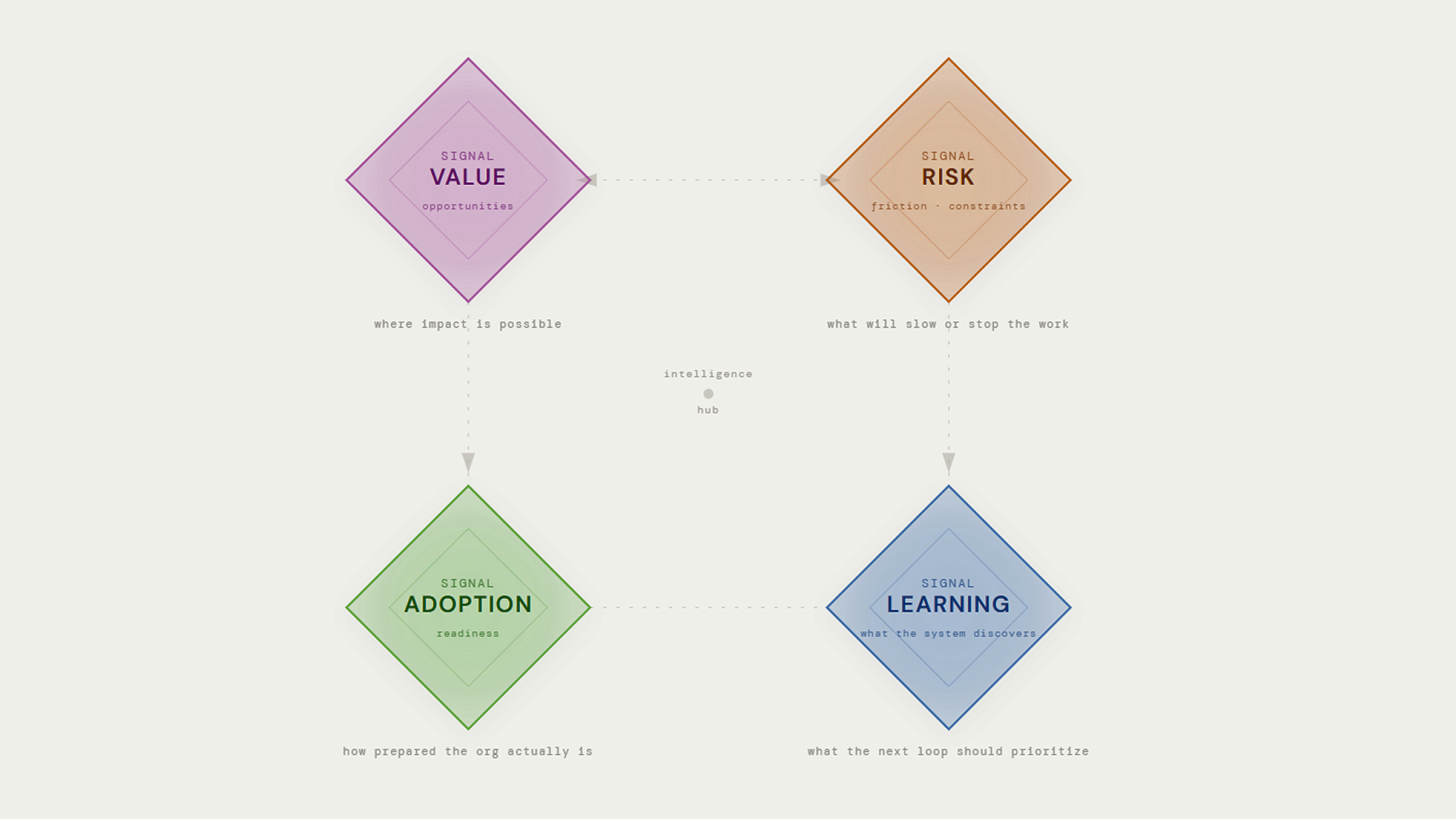
These four signals move in both directions. From the orbits into the Hub — feeding what the system knows. From the Hub back into the orbits — shaping what the team does next. This bidirectional flow is not a feature of MESH. It is the mechanism by which the system learns. An organization that captures signals only at the beginning of an initiative and ignores what the system generates during build and deployment is not operating MESH. It is operating a waterfall process with better tools.
The distinction matters because signals change. The opportunity identified in the first week of Sense may look different by the end of Shape. The adoption risk that seemed manageable in planning may become the dominant constraint during Scale. A system designed to act on signals only at fixed points cannot respond to this. MESH can — because the signals never stop.
The orbits are terrain, not path.
If Sense, Shape, and Scale describe how the team moves, the four orbits describe where the work is focused. These are not the same thing. Understanding the difference is what separates MESH from a process with renamed stages.
The orbits are terrain, not path. An organization does not graduate from Discovery to Opportunity to Enablement to Execution in sequence. Multiple initiatives exist on different orbits simultaneously. A team can be deep in Execution on one pilot while entering Discovery on the next signal. The system is always in motion across all four. What changes is where attention is concentrated and what kind of work is being done.
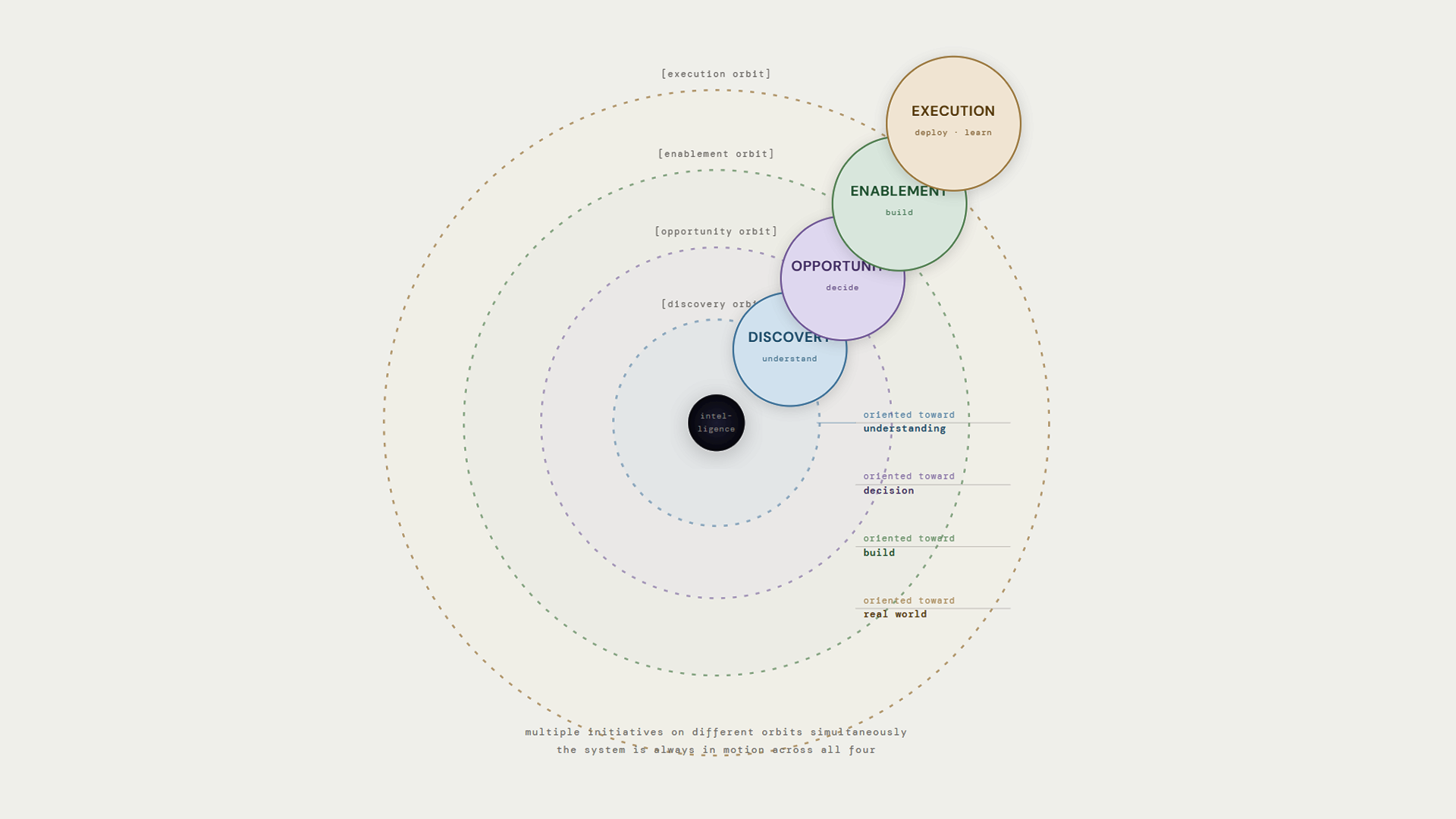
The Discovery orbit is where the organization is oriented toward understanding. Reading signals, assessing readiness, identifying where AI integration creates real value. This is not a research phase that requires weeks of workshops and stakeholder interviews. In a high-functioning team operating with an active Intelligence Hub, Discovery can be compressed dramatically — because the system already knows things. The Hub remembers what previous loops revealed. The Augmentation Team reads the environment and the Hub simultaneously.
The Opportunity orbit is where the organization is oriented toward decision. Candidate pilots are evaluated, options are weighted, and the question shifts from what is the system telling us to what is the right first move. The boundary between Discovery and Opportunity is not a gate. It is a moment — when enough signals have been surfaced that the direction becomes clear. The boundary between Opportunity and the next orbit is different. It is a readiness signal. From the client, the organization, or the system itself.
The Enablement orbit is where the organization is oriented toward build. Everything the development team needs is produced here — structured, machine-readable, AI-native. BRD, technical requirements, conceptual data architecture, process and signal flows, augmentation maps, context files, prototype with embedded annotations. Not deliverables for a presentation. Infrastructure for what comes next. The project type determines the configuration: workflow integration, AI into existing software, or AI-native application built from the ground up. The output spine is consistent. The contents vary.
The Execution orbit is where the organization is oriented toward the real world. Adoption, integration, expansion into live workflows. This is where the system encounters actual users, actual constraints, actual feedback. It is also where the next round of sensing begins. Scale and Sense run simultaneously in Execution — because an organization serious about AI-era innovation does not wait for one initiative to complete before the system starts reading what comes next. The four orbits are not destinations. They are the operating conditions the system moves through, continuously, as long as the organization is running MESH.
Two different ways AI participates in the system.
MESH makes a distinction most AI implementation strategies do not. There are two different ways AI participates in the system, and conflating them is one of the most common reasons AI initiatives fail to scale.
The first is the AI partnership layer. This is the Augmentation Team's AI member — the thinking partner, the synthesis engine, the memory that holds context across the work and surfaces patterns the human members might miss. This layer informs decisions. It expands the solution space before the human decides what is real. It is strategic, continuous, and deeply integrated into how the team operates. It is not a tool that gets picked up and put down. It is a participant in every loop.
The second is the agent layer. Agents are specific, automated actors that execute defined tasks at defined moments across the orbits. They are not abstract AI assistance. They are operational — a specific agent generating a specific artifact at a specific point in the workflow, another agent running a specific validation, another monitoring a specific signal type and flagging when it crosses a threshold. They appear where they are needed, do what they are designed to do, and step back. Ephemeral by nature. Precise by design.
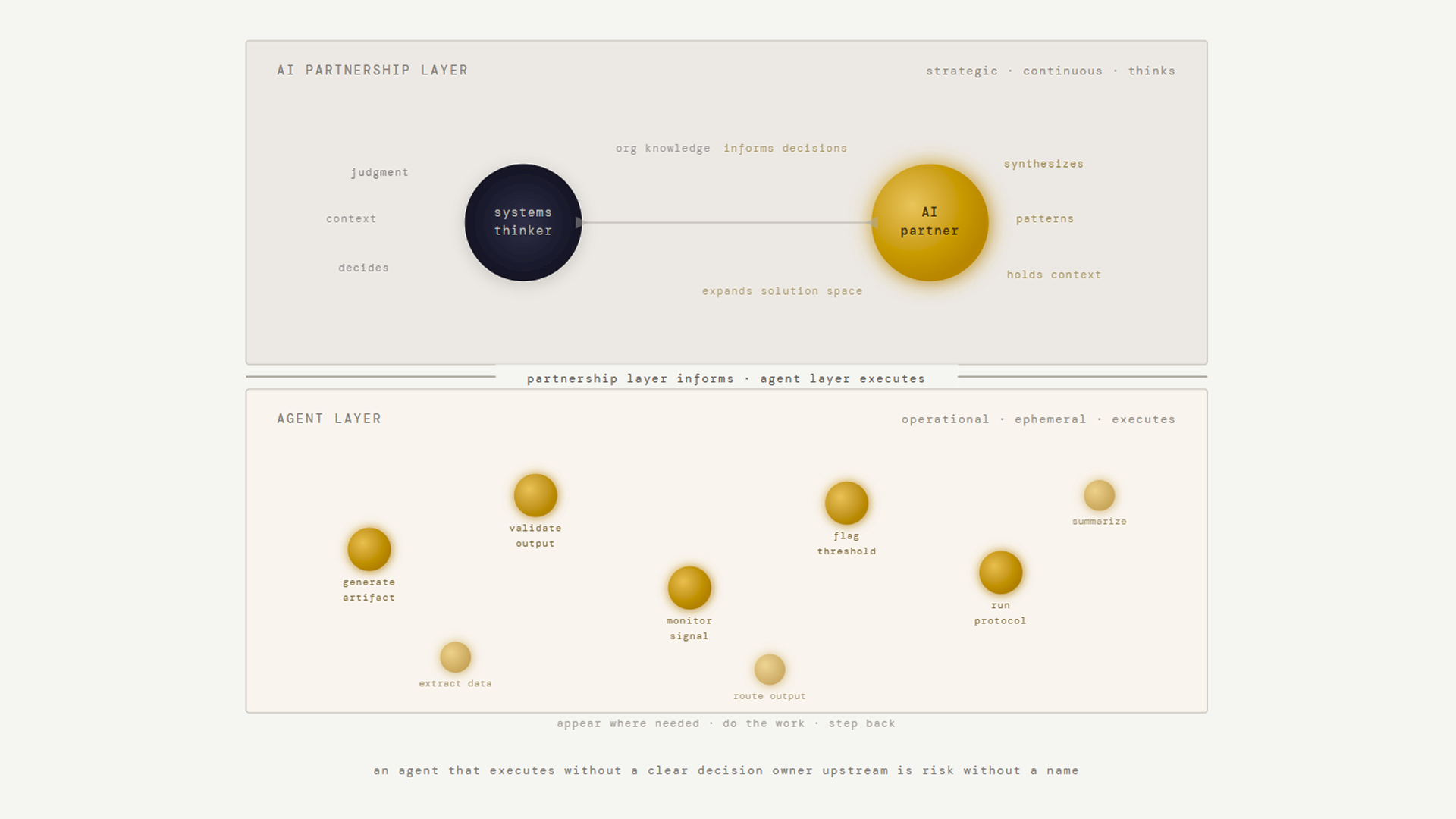
The governance implication is direct. The partnership layer informs decisions. The agent layer executes them. Accountability must be designed around both — explicitly, deliberately, by the same team that designs the system. An agent that executes without a clear decision owner upstream is not automation. It is risk without a name.
In a lean MESH operation, the distinction between these two layers is what keeps the system coherent as it scales. The partnership layer holds the intelligence. The agent layer extends the reach. Neither replaces the other. Neither works without the other.
MESH does not work without the right people operating it.
MESH does not work without the right people operating it. This is not a limitation of the system. It is a design principle.
The Augmentation Team is the human and AI composition that runs MESH. Strategy, product, technology, and AI — not as departments or disciplines, but as lenses. Each member reads the same environment differently. The strategist sees organizational dynamics and decision patterns. The product mind sees user behavior and value creation. The technologist sees what is buildable, what is brittle, and what the existing system will and will not absorb. The AI partner sees across all of it — synthesizing, pattern-matching, holding context, accelerating the movement between signal and decision and build.
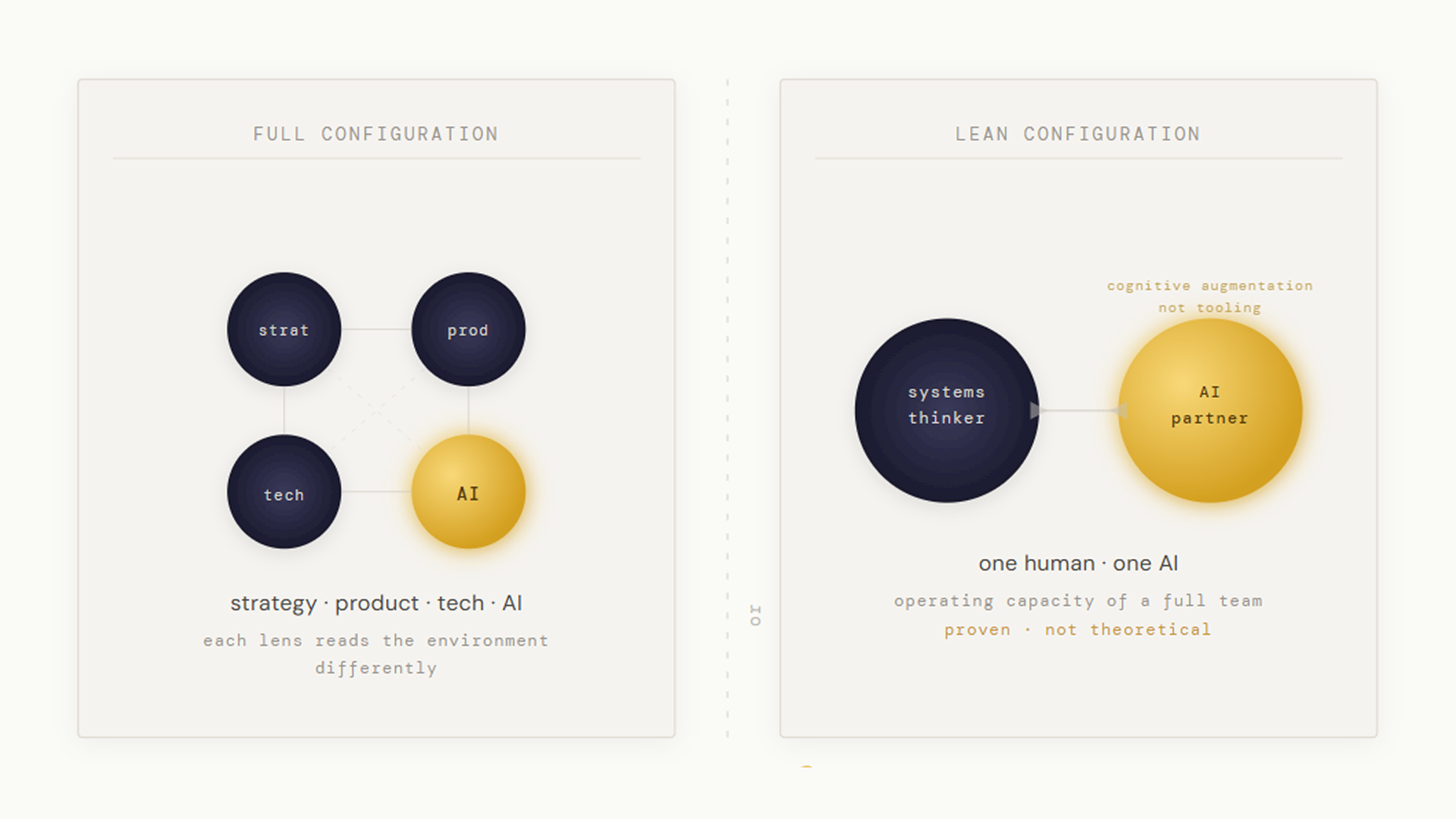
In a full organizational deployment, these are distinct people. In a lean operation, they collapse. A single systems thinker can hold strategy and product simultaneously. An AI partner can extend the reach of one person into the operating capacity of a team. The minimum viable Augmentation Team is not a theoretical minimum. It has been tested. One systems thinker, one AI partner, producing a 100-page software audit in hours instead of weeks. Generating complete development documentation packages ready for AI-powered build environments. Reading an organization's constraints, identifying the right pilot, speccing it, and handing it off — without a discovery workshop, without a steering committee, without a gate review.
This is not what most organizations are built to accept. It requires a different kind of trust — in the system, in the practitioner, and in the AI partner as a genuine participant rather than a productivity tool. It also requires a different kind of practitioner. Not a specialist who executes within a defined lane. A systems thinker who reads the whole environment, makes decisions under uncertainty, and moves before the signal changes.
MESH does not end. That is the point.
MESH does not end. That is the point.
Most innovation processes are designed around completion. A project has a start, a set of phases, and a finish line. The organization crosses it, declares success or failure, and moves on. The intelligence generated along the way — what worked, what the system revealed, what users actually did — is captured in a final report that few people read and fewer act on. The next initiative starts from somewhere close to zero.
MESH is designed around the opposite assumption. Every loop generates intelligence that makes the next loop faster. Every signal that flows into the Hub during Execution becomes context for the next round of Sense. Every adoption friction surfaced during Scale becomes an input to the next Enablement. The system does not reset. It learns.
This is what continuous operation actually means — not that the team never stops working, but that the system never stops accumulating. An organization running MESH for twelve months does not have twelve months of completed projects. It has twelve months of accumulated intelligence — patterns recognized, decisions calibrated, signals understood at a depth that no newcomer to the environment can replicate quickly. That intelligence lives in the Hub. It compounds.
The loop is the operating rhythm. Signal. Decision. Build. Adoption. Learning. Signal again. Not as a cycle that repeats identically — as a spiral that tightens. Each pass through the system is informed by everything that came before it. The decisions get sharper. The build gets faster. The adoption gets smoother. Not because the team got lucky. Because the system got smarter.